
📖 Step 2 — Learning Material
🔹 1️⃣ Introduction
The Hexose Monophosphate (HMP) Shunt, also called the Pentose Phosphate Pathway (PPP), is an alternative pathway of glucose metabolism occurring in the cytoplasm. Unlike glycolysis, its primary purpose is not ATP production but the generation of NADPH and ribose-5-phosphate. NADPH is essential for antioxidant defense, fatty acid synthesis, steroid synthesis, and maintaining reduced glutathione inside cells. The pathway is especially important in red blood cells, liver, adipose tissue, adrenal cortex, lactating mammary gland, and rapidly dividing cells. Clinically, deficiency of the enzyme glucose-6-phosphate dehydrogenase (G6PD) causes oxidative damage and hemolytic anemia. Understanding this pathway explains how cells protect themselves against oxidative stress and how metabolism supports biosynthesis.
🔹 2️⃣ Foundation Concepts
Key Definitions
- Hexose Monophosphate (HMP) Shunt: Alternative pathway of glucose oxidation producing NADPH and pentoses.
- Pentose Phosphate Pathway (PPP): Another name for HMP shunt.
- NADPH: Reduced coenzyme used in reductive biosynthesis and antioxidant defense.
- Ribose-5-phosphate: Sugar required for nucleotide and nucleic acid synthesis.
- Oxidative Phase: Irreversible part producing NADPH.
- Non-oxidative Phase: Reversible interconversion of sugars.
- G6PD: Rate-limiting enzyme of HMP shunt.
- Glutathione: Major intracellular antioxidant.
Essential Terminology
- Cytoplasmic pathway
- Oxidation–reduction reactions
- Oxidative stress
- Reactive oxygen species (ROS)
- Ribulose-5-phosphate
- Transketolase
- Transaldolase
- Reduced glutathione (GSH)
Basic Overview
- Occurs in cytoplasm.
- Begins with glucose-6-phosphate.
- Does not directly produce ATP.
- Generates NADPH and pentose sugars.
- Has oxidative and non-oxidative phases.
- Highly active in tissues needing fatty acid or steroid synthesis.
- Essential in RBC antioxidant defense.
🔹 3️⃣ Core Learning — Curriculum Coverage
A. Role of Pentose Phosphate Pathway
🧠 CORE
- Alternative pathway of glucose metabolism.
- Occurs in cytoplasm.
- Main product is NADPH.
- Produces ribose-5-phosphate.
- Does not generate ATP.
- Protects cells from oxidative injury.
- Supports biosynthetic reactions.
- Important in RBC survival.
🔬 CONCEPT EXPLAINED
The pentose phosphate pathway diverts glucose-6-phosphate away from glycolysis. Instead of producing energy, the pathway mainly produces NADPH and pentose sugars.
NADPH acts as a reducing agent. It provides electrons for:
- Fatty acid synthesis
- Cholesterol synthesis
- Steroid hormone synthesis
- Detoxification reactions
- Maintenance of reduced glutathione
Ribose-5-phosphate is required for synthesis of:
- DNA
- RNA
- ATP
- Nucleotides
Thus, the pathway exists mainly to support:
- Antioxidant defense
- Biosynthesis
- Rapidly dividing cells
⚠️ IF DAMAGED
Cause → Effect
Reduced HMP activity
→ Less NADPH production
→ Failure to maintain reduced glutathione
→ Oxidative damage to cell membrane
→ Hemolysis in RBCs
Deficient ribose synthesis
→ Reduced nucleotide production
→ Impaired cell growth and repair
B. Tissues Where HMP Shunt Occurs
🧠 CORE
The pathway is highly active in:
- Liver
- Adipose tissue
- Adrenal cortex
- Lactating mammary gland
- Testes
- Ovaries
- Thyroid gland
- Red blood cells
- Rapidly dividing cells
🔬 CONCEPT EXPLAINED
The HMP shunt is most active in tissues requiring large amounts of NADPH.
Liver and Adipose Tissue
Need NADPH for fatty acid and cholesterol synthesis.
Adrenal Cortex and Gonads
Need NADPH for steroid hormone synthesis.
RBCs
Require NADPH to maintain reduced glutathione against oxidative stress because RBCs lack mitochondria.
Rapidly Dividing Cells
Need ribose-5-phosphate for nucleotide synthesis.
Structure → Function relationship:
- Cells with active biosynthesis require reducing power.
- HMP shunt provides this reducing power as NADPH.
⚠️ IF DAMAGED
Reduced NADPH production
→ Impaired lipid and steroid synthesis
→ Cellular dysfunction
In RBCs:
Oxidative injury
→ Membrane damage
→ Heinz body formation
→ Hemolytic anemia
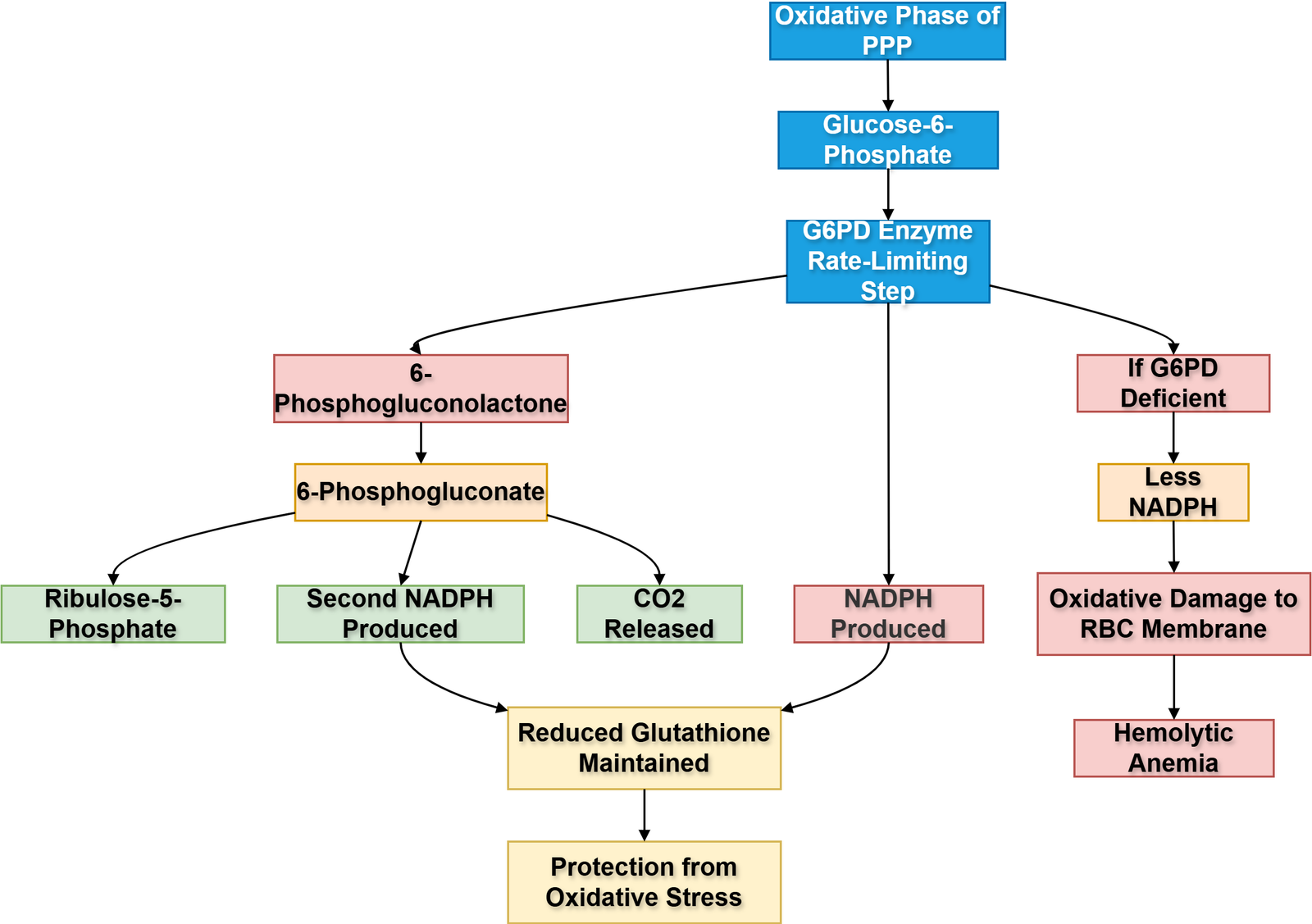
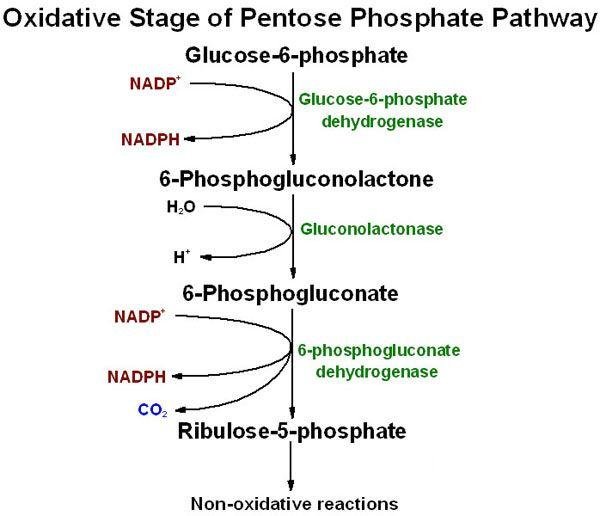
C. Reactions of Oxidative Phase
🧠 CORE
- Irreversible phase.
- Produces NADPH.
- Begins with glucose-6-phosphate.
- Controlled by G6PD enzyme.
- Produces ribulose-5-phosphate.
- Generates CO₂.
- Main regulatory phase.
🔬 CONCEPT EXPLAINED
The oxidative phase converts glucose-6-phosphate into ribulose-5-phosphate.
Major Steps
- Glucose-6-phosphate
→ oxidized by G6PD
→ forms 6-phosphogluconolactone - Formation of NADPH.
- Further oxidation and decarboxylation occur.
- Ribulose-5-phosphate is produced.
This phase is irreversible and serves as the major source of NADPH.
⚠️ IF DAMAGED
G6PD deficiency
→ Reduced NADPH
→ Inability to neutralize ROS
→ Oxidative hemolysis
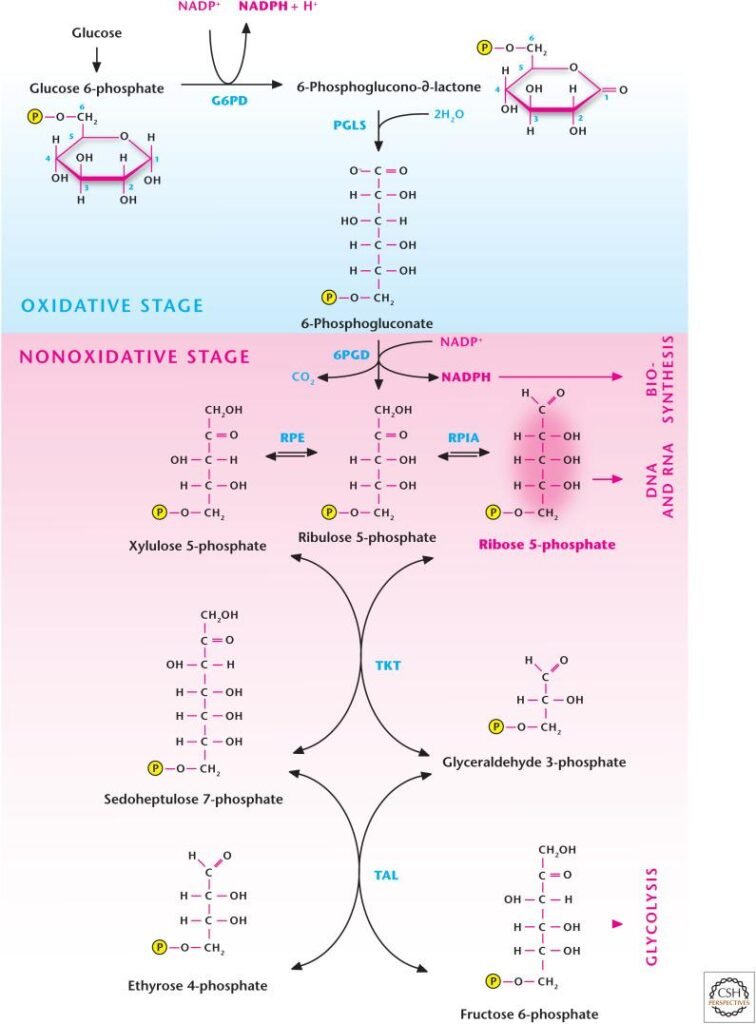
D. Reactions of Non-Oxidative Phase
🧠 CORE
- Reversible phase.
- Interconverts sugars.
- Produces glycolytic intermediates.
- Uses transketolase and transaldolase.
- Generates ribose sugars.
- Links PPP with glycolysis.
🔬 CONCEPT EXPLAINED
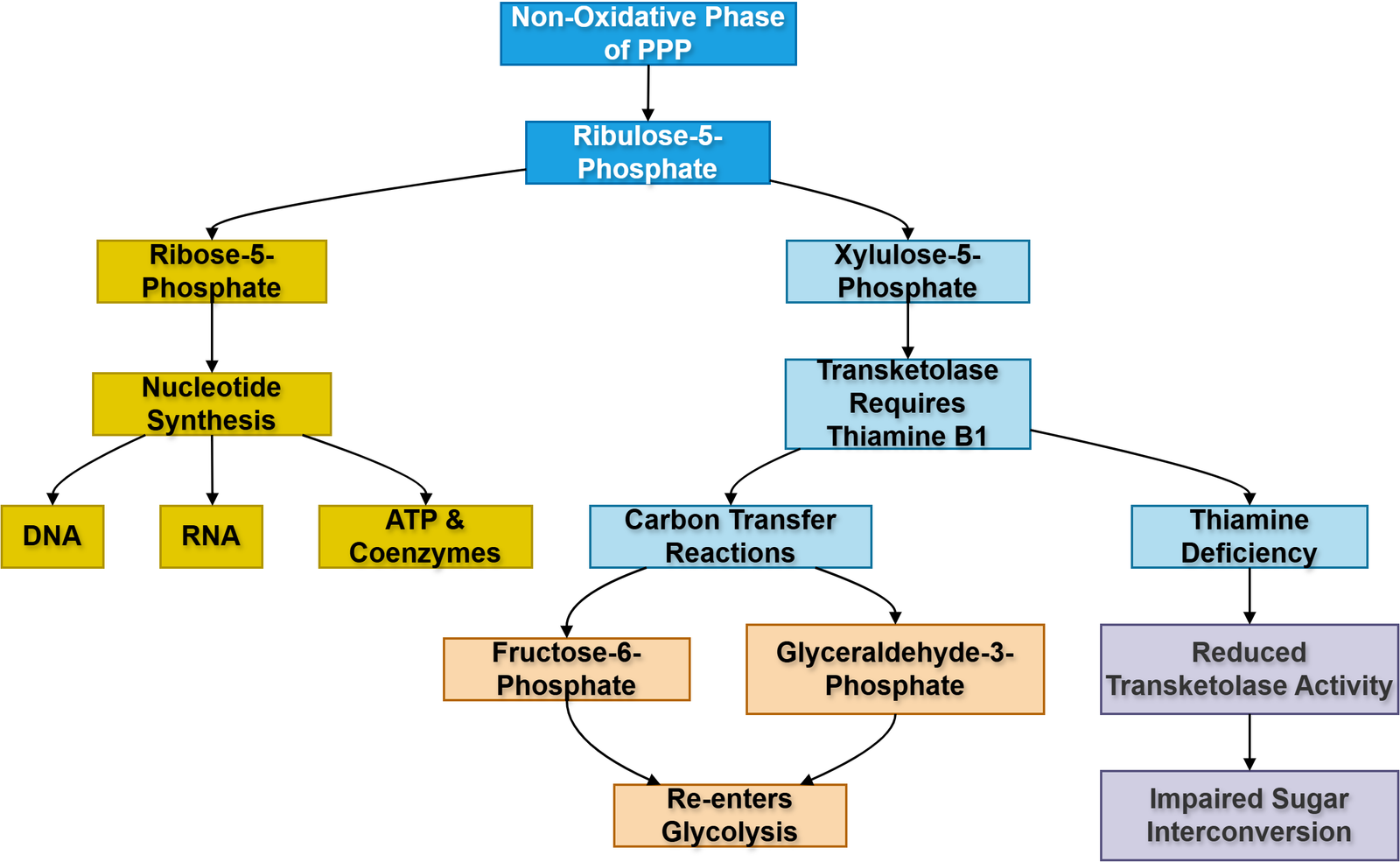
The non-oxidative phase rearranges carbon skeletons of sugars.
Key enzymes:
- Transketolase
- Transaldolase
Products formed:
- Fructose-6-phosphate
- Glyceraldehyde-3-phosphate
These intermediates can re-enter glycolysis.
This phase allows flexibility:
- Cells needing ribose only can generate it.
- Cells needing NADPH can recycle sugars back into pathway.
⚠️ IF DAMAGED
Defective transketolase activity
→ Impaired sugar interconversion
→ Reduced nucleotide synthesis
Thiamine deficiency
→ Reduced transketolase activity
→ Metabolic dysfunction
E. Role of Thiamine
🧠 CORE
- Thiamine acts as TPP.
- Required for transketolase activity.
- Important in non-oxidative phase.
- Supports carbon transfer reactions.
🔬 CONCEPT EXPLAINED
Thiamine pyrophosphate (TPP) is a coenzyme for transketolase.
Transketolase transfers two-carbon units between sugars during the non-oxidative phase.
Without thiamine:
- Carbon transfer reactions slow
- Sugar interconversion becomes defective
⚠️ IF DAMAGED
Thiamine deficiency
→ Reduced transketolase activity
→ Impaired PPP function
→ Neurological and metabolic disturbances
F. Similarities and Differences Between Glycolysis and HMP Pathway
🧠 CORE
Similarities
- Both occur in cytoplasm.
- Both start with glucose-6-phosphate.
- Both involve enzyme-mediated reactions.
Differences
- Glycolysis produces ATP.
- HMP pathway produces NADPH.
- Glycolysis mainly provides energy.
- HMP pathway mainly supports biosynthesis and antioxidant defense.
🔬 CONCEPT EXPLAINED
Glycolysis and HMP pathway are parallel pathways of glucose metabolism.
Glycolysis
Purpose:
- ATP generation
Main product:
- Pyruvate
HMP Pathway
Purpose:
- NADPH and ribose synthesis
Main products:
- NADPH
- Ribose-5-phosphate
Thus:
Energy pathway → Glycolysis
Protective/Biosynthetic pathway → HMP shunt
⚠️ IF DAMAGED
Failure of glycolysis
→ Energy depletion
Failure of HMP shunt
→ Oxidative stress and biosynthetic failure
G. Functions of NADPH
🧠 CORE
NADPH is required for:
- Fatty acid synthesis
- Cholesterol synthesis
- Steroid synthesis
- Maintenance of glutathione
- Respiratory burst in neutrophils
- Cytochrome P450 reactions
- Nitric oxide synthesis
🔬 CONCEPT EXPLAINED
NADPH provides reducing power.
Antioxidant Defense
Maintains glutathione in reduced form.
Biosynthesis
Used in synthesis of lipids and steroids.
Immune Function
Neutrophils use NADPH oxidase for respiratory burst to kill bacteria.
Detoxification
Cytochrome P450 system requires NADPH.
Structure → Function:
Electron donation by NADPH enables reduction reactions.
⚠️ IF DAMAGED
Low NADPH
→ Oxidative stress
→ Hemolysis
→ Reduced immune killing
→ Impaired detoxification
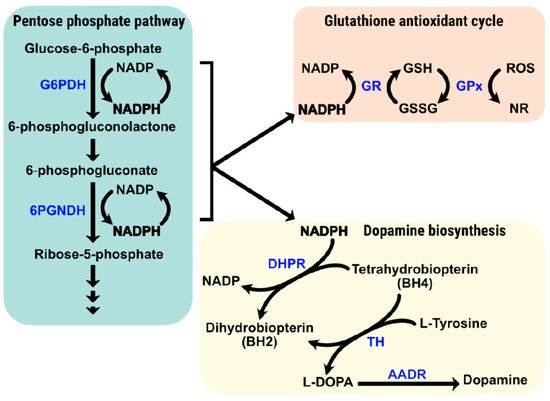
H. G6PD Deficiency
🧠 CORE
- Most common enzyme deficiency worldwide.
- X-linked recessive disorder.
- Causes reduced NADPH production.
- RBCs become vulnerable to oxidative stress.
- Causes hemolytic anemia.
- Triggered by infections, drugs, fava beans.
🔬 CONCEPT EXPLAINED
G6PD is the rate-limiting enzyme of HMP shunt.
RBCs depend entirely on HMP pathway for NADPH because they lack mitochondria.
Without NADPH:
- Glutathione cannot remain reduced.
- Oxidative damage accumulates.
- Hemoglobin precipitates as Heinz bodies.
- RBC membrane becomes fragile.
Common triggers:
- Sulfonamides
- Antimalarials
- Infections
- Fava beans
⚠️ IF DAMAGED
G6PD deficiency
→ ↓ NADPH
→ ↓ Reduced glutathione
→ Oxidative membrane injury
→ Heinz bodies
→ Hemolytic anemia
→ Jaundice and dark urine
I. Regulation of HMP Pathway
🧠 CORE
- Controlled mainly by G6PD.
- NADP⁺ activates pathway.
- NADPH inhibits pathway.
- Insulin increases enzyme synthesis.
- Pathway activity depends on cellular NADPH demand.
🔬 CONCEPT EXPLAINED
The rate of the pathway changes according to need for NADPH.
High NADP⁺
Indicates NADPH deficiency
→ Activates G6PD
High NADPH
Indicates adequate reducing power
→ Inhibits G6PD
Insulin stimulates pathway in:
- Liver
- Adipose tissue
because lipogenesis requires NADPH.
⚠️ IF DAMAGED
Poor regulation
→ Inadequate antioxidant defense
→ Reduced biosynthesis
→ Increased oxidative injury
⚙️ 4️⃣ Functional Flow
Structure → Function → Outcome
Glucose-6-phosphate diversion into PPP
→ NADPH generation
→ Antioxidant protection and biosynthesis
RBC dependence on PPP
→ Maintenance of reduced glutathione
→ Prevention of oxidative hemolysis
Transketolase activity
→ Sugar interconversion
→ Ribose production for nucleic acid synthesis
NADPH production in neutrophils
→ Respiratory burst
→ Bacterial killing
🩺 5️⃣ Clinical Correlation
G6PD Deficiency
- X-linked recessive disorder
- Common in malaria-endemic regions
- Causes episodic hemolytic anemia
Triggers
- Sulfa drugs
- Primaquine
- Infections
- Fava beans
Clinical Features
- Jaundice
- Fatigue
- Dark urine
- Heinz bodies
- Bite cells
Oxidative Stress in RBCs
RBCs lack mitochondria
→ Depend completely on HMP shunt
→ Highly vulnerable to oxidative injury
Thiamine Deficiency
Reduced transketolase activity
→ Impaired non-oxidative phase
📌 6️⃣ Summary Points
- HMP shunt occurs in cytoplasm.
- Main products are NADPH and ribose-5-phosphate.
- Pathway does not produce ATP.
- G6PD is rate-limiting enzyme.
- Oxidative phase is irreversible.
- Non-oxidative phase is reversible.
- NADPH maintains reduced glutathione.
- RBCs rely heavily on HMP pathway.
- G6PD deficiency causes hemolytic anemia.
- Transketolase requires thiamine.
- HMP shunt supports fatty acid and steroid synthesis.
- NADPH is essential for respiratory burst in neutrophils.