
💡 Study Tip: For a wider reading view, click the ⬅ arrow beside the course title to hide the course content sidebar.
📖 Step 2 — Learning Material
🔹 1️⃣ Introduction
- The liver is the largest metabolic organ located in the right upper abdomen.
- It plays a central role in detoxification, metabolism, and bile production.
- Diseases of the liver affect multiple body systems due to its wide functions.
- Hepatitis and cirrhosis are among the most common global liver diseases.
- Drug metabolism occurs mainly in the liver, making it vulnerable to toxicity.
- Obstructive jaundice reflects biliary system dysfunction and is clinically important.
- Understanding these basics helps in early diagnosis and prevention of complications.
🔹 2️⃣ Foundation Concepts
- Hepatitis = Inflammation of liver
- Cirrhosis = Irreversible fibrosis + nodular regeneration
- Jaundice = Yellow discoloration due to ↑ bilirubin
- Hepatotoxicity = Liver damage caused by drugs/toxins
- First-pass metabolism = Drug metabolism before reaching systemic circulation
- Obstructive jaundice = Blockage in bile flow
🔹 3️⃣ Core Learning — Curriculum Coverage
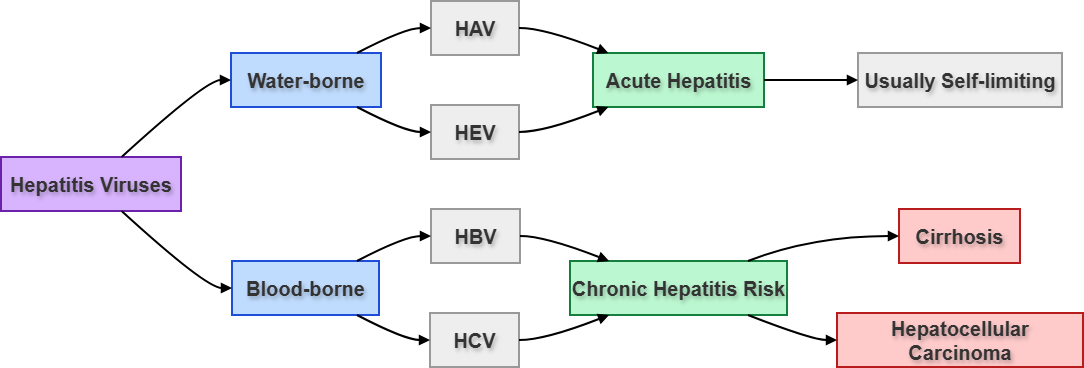
🔹1. Viruses causing acute hepatitis
🧠 CORE
- Acute hepatitis = sudden liver inflammation
- Common viruses:
- Hepatitis A (HAV)
- Hepatitis E (HEV)
- Transmission:
- Feco-oral route
- Usually self-limiting
- No chronic stage (important exam point)
- Affects younger population commonly
🔬 CONCEPT EXPLAINED
- Virus enters via contaminated food/water
- Travels to liver → infects hepatocytes
- Immune response causes inflammation
- Liver cells temporarily damaged but regenerate
⚠️ IF DAMAGED
- Cause: Severe infection
- Effect:
- Jaundice
- Mild liver dysfunction
- Rarely acute liver failure
🔹2. Viruses causing chronic hepatitis
🧠 CORE
- Chronic hepatitis = >6 months inflammation
- Main viruses:
- Hepatitis B (HBV)
- Hepatitis C (HCV)
- Transmission:
- Blood
- Sexual contact
- Can progress to cirrhosis and cancer
🔬 CONCEPT EXPLAINED
- Virus persists in hepatocytes
- Continuous immune attack → chronic inflammation
- Leads to fibrosis over time
⚠️ IF DAMAGED
- Cause: Persistent infection
- Effect:
- Chronic liver damage
- Cirrhosis
- Hepatocellular carcinoma
🔹3. Pathogenesis of liver cirrhosis
🧠 CORE
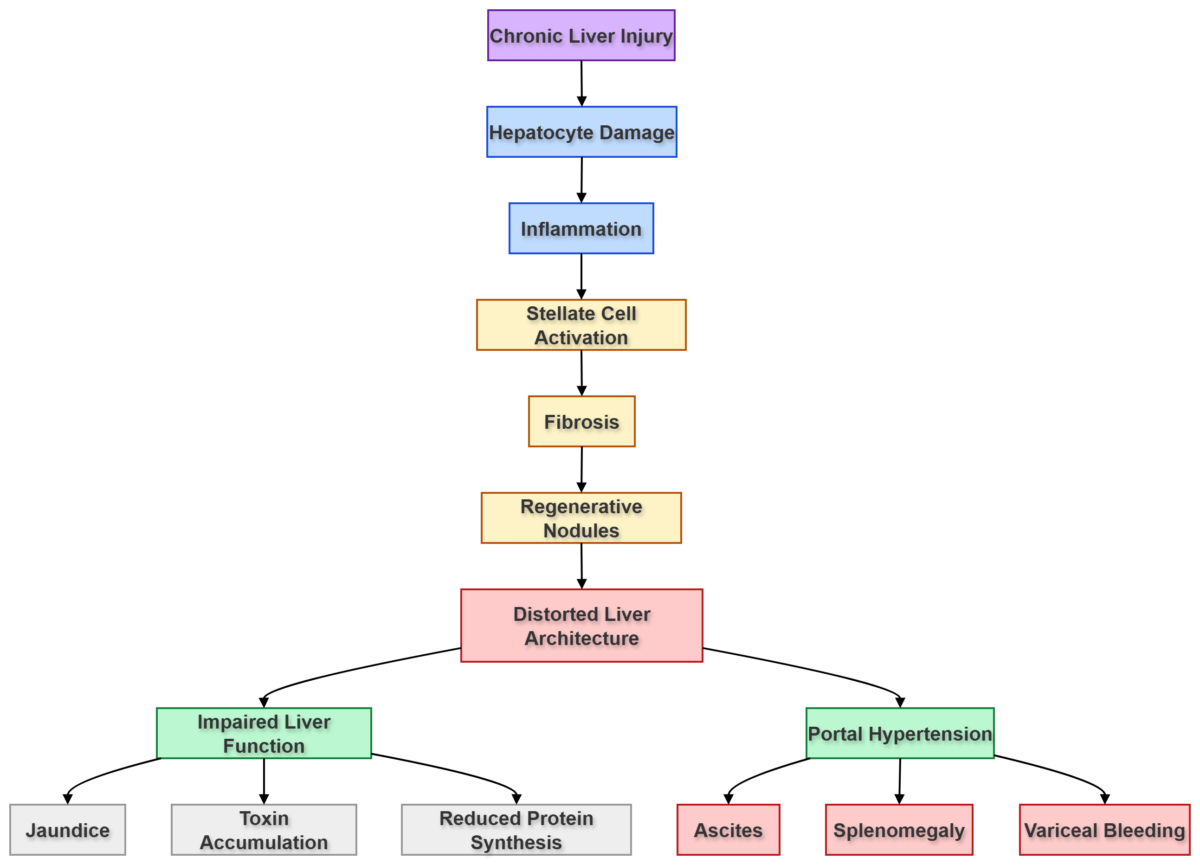
- Cirrhosis = diffuse fibrosis + nodules
- Causes:
- Chronic hepatitis
- Alcohol
- Key feature = distorted liver architecture
- Leads to portal hypertension
🔬 CONCEPT EXPLAINED
- Repeated injury → hepatocyte death
- Activation of stellate cells → fibrosis
- Fibrous bands form → nodules develop
- Blood flow becomes abnormal
⚠️ IF DAMAGED
- Cause: Progressive fibrosis
- Effect:
- Portal hypertension
- Liver failure
🔹4. Stages of liver cirrhosis
🧠 CORE
- Early: Compensated stage
- Late: Decompensated stage
- Compensated = liver still functions
- Decompensated = liver failure signs
🔬 CONCEPT EXPLAINED
- Initially liver adapts
- Later damage exceeds repair capacity
⚠️ IF DAMAGED
- Cause: Progression
- Effect:
- Ascites
- Encephalopathy
- Bleeding
🔹5. Clinical presentation of liver cirrhosis
🧠 CORE
- Fatigue
- Jaundice
- Ascites
- Hepatomegaly (early)
- Splenomegaly
- Spider angiomas
🔬 CONCEPT EXPLAINED
- Portal hypertension → ascites, splenomegaly
- Liver failure → toxin accumulation → encephalopathy
⚠️ IF DAMAGED
- Cause: Advanced disease
- Effect:
- Multi-organ impact
🔹6. Drug detoxification in liver
🧠 CORE
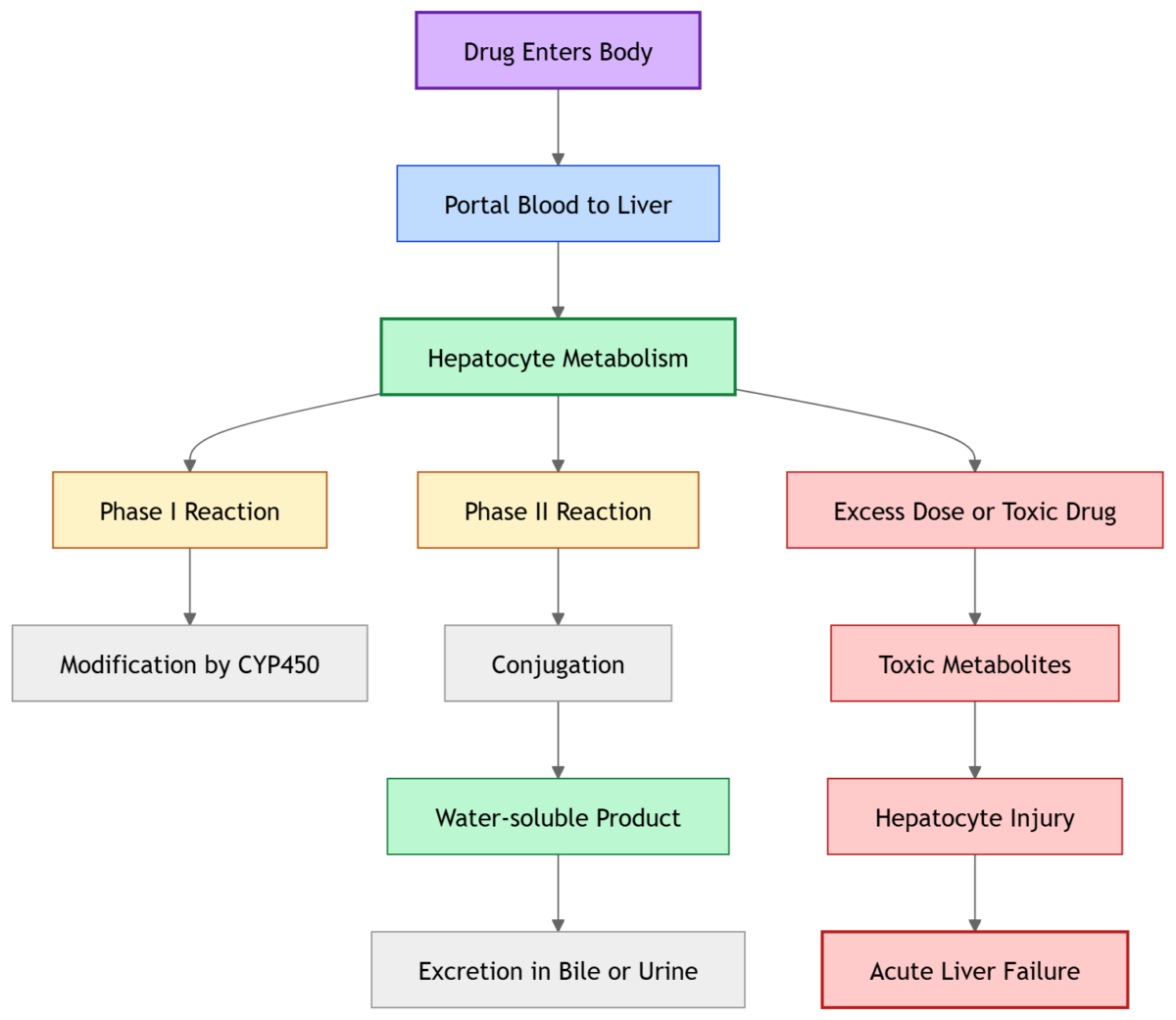
- Liver removes toxins from blood
- Uses enzymes mainly in hepatocytes
- Converts toxic substances → harmless
🔬 CONCEPT EXPLAINED
- Blood enters liver via portal vein
- Hepatocytes metabolize toxins
- Products excreted via bile or urine
⚠️ IF DAMAGED
- Cause: Liver failure
- Effect:
- Toxin accumulation
- Drug toxicity
🔹7. Hepatic drug metabolism
🧠 CORE
- Two phases:
- Phase I → modification
- Phase II → conjugation
- Occurs in hepatocytes
🔬 CONCEPT EXPLAINED
- Phase I: oxidation (Cytochrome P450)
- Phase II: conjugation → water soluble
- Enables excretion
⚠️ IF DAMAGED
- Cause: Enzyme failure
- Effect:
- Drug accumulation
- Increased toxicity
🔹 First-pass metabolism
🧠 CORE
- Drug metabolized in liver before systemic circulation
- Reduces drug bioavailability
🔬 CONCEPT EXPLAINED
- Oral drug → intestine → portal vein → liver
- Significant portion metabolized
- Only fraction reaches systemic circulation
⚠️ IF DAMAGED
- Cause: Liver disease
- Effect:
- Increased drug levels
🔹8. Hepatotoxic drugs
🧠 CORE
- Drugs causing liver injury:
- Paracetamol (overdose)
- Anti-TB drugs
- Dose-dependent or idiosyncratic
🔬 CONCEPT EXPLAINED
- Toxic metabolites damage hepatocytes
- Leads to necrosis or inflammation
⚠️ IF DAMAGED
- Cause: Overdose/toxicity
- Effect:
- Acute liver failure
🔹9. Hepatotoxic poisons (Forensic)
🧠 CORE
- Examples:
- Alcohol
- Industrial toxins
- Cause severe liver damage
🔬 CONCEPT EXPLAINED
- Toxins directly damage liver cells
- Affect metabolism and detoxification
⚠️ IF DAMAGED
- Cause: Poison exposure
- Effect:
- Liver necrosis
🔹10 Epidemiology of Hepatitis B & C
🧠 CORE
- HBV & HCV common globally
- Spread via:
- Blood
- Needles
- Sexual contact
🔬 CONCEPT EXPLAINED
- Poor sterilization → transmission
- Chronic infection leads to complications
⚠️ IF DAMAGED
- Effect:
- High disease burden
- Chronic liver disease
🔹11. Hepatitis A & E (Community Medicine)
🧠 CORE
- Water-borne infections
- Spread via contaminated water
- Common in developing countries
🔬 CONCEPT EXPLAINED
- Poor sanitation → outbreaks
- Affect large populations
⚠️ IF DAMAGED
- Effect:
- Epidemics
🔹12. Etiology of liver cirrhosis (Medicine)
🧠 CORE
- Alcohol
- Chronic hepatitis B & C
- Fatty liver disease
🔬 CONCEPT EXPLAINED
- Long-term injury leads to fibrosis
⚠️ IF DAMAGED
- Effect:
- End-stage liver disease
🔹13. Complications of liver cirrhosis
🧠 CORE
- Portal hypertension
- Ascites
- Hepatic encephalopathy
- Variceal bleeding
🔬 CONCEPT EXPLAINED
- Increased pressure → collateral circulation
- Toxin buildup → brain dysfunction
⚠️ IF DAMAGED
- Effect:
- Life-threatening complications
🔹14. Obstructive jaundice (Surgery)
🧠 CORE
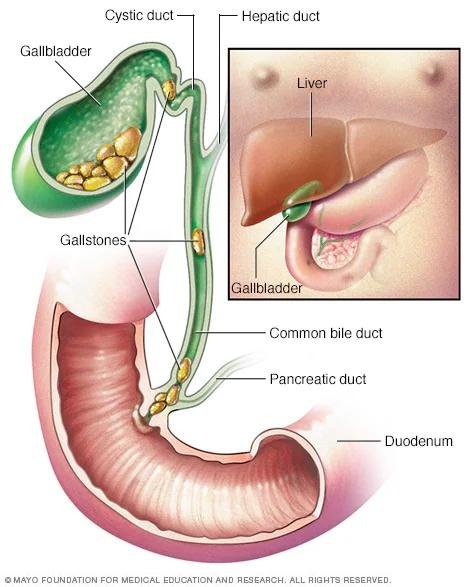
- Caused by blockage of bile flow
- Causes:
- Gallstones
- Tumors
- Conjugated bilirubin ↑
🔬 CONCEPT EXPLAINED
- Bile cannot reach intestine
- Accumulates in blood
⚠️ IF DAMAGED
- Effect:
- Pale stools
- Dark urine
- Itching
⚙️ 4️⃣ Functional Flow
Obstructive Jaundice Flow:
- Bile duct obstruction
- Bile flow blocked
- Conjugated bilirubin accumulates
- Enters bloodstream
- Jaundice appears
- No bile in intestine → pale stool
📌 6️⃣ Summary Points
- HAV & HEV → acute, no chronic stage
- HBV & HCV → chronic disease risk
- Cirrhosis = fibrosis + nodules
- Portal hypertension = key complication
- Liver = main detox organ
- Phase I & II metabolism essential
- First-pass metabolism reduces drug effect
- Paracetamol overdose → liver failure
- Obstructive jaundice → pale stool + dark urine