
📖 Step 2 — Learning Material
🔹 1️⃣ Introduction
Vomiting is an important protective reflex of the gastrointestinal tract. It helps the body expel harmful substances, toxins, irritants, or excessive gastric contents. Nausea and vomiting involve coordinated activity of the stomach, intestine, diaphragm, abdominal muscles, and brainstem vomiting center. Gastrointestinal obstruction interferes with normal movement of intestinal contents and may produce distension, pain, vomiting, and constipation. Gases in the gastrointestinal tract are normally produced and expelled as flatus, but excessive gas can cause bloating and discomfort. Intestinal secretions are essential for digestion, lubrication, protection of mucosa, and absorption of nutrients.
🔹 2️⃣ Foundation Concepts
Key Definitions
- Nausea: Unpleasant sensation of desire to vomit.
- Vomiting: Forceful expulsion of gastric contents through the mouth.
- Retching: Repeated respiratory and abdominal movements without expulsion of gastric contents.
- Vomiting center: Brainstem center in medulla that coordinates vomiting.
- Chemoreceptor trigger zone: Area that detects toxins, drugs, and metabolic chemicals in blood.
- Gastrointestinal obstruction: Blockage that prevents normal movement of intestinal contents.
- Flatus: Gas expelled from the gastrointestinal tract through the anus.
- Intestinal juice: Fluid secreted by intestinal glands containing water, electrolytes, mucus, and enzymes.
🔹 3️⃣ Core Learning — Curriculum Coverage
Physiology Objective 1: Mechanism and Causes of Nausea
🧠 CORE
- Nausea is the feeling of impending vomiting.
- It usually occurs before vomiting.
- It is controlled mainly by brainstem centers.
- It may be triggered by GI irritation, toxins, drugs, motion, pregnancy, or raised intracranial pressure.
- Autonomic symptoms often accompany nausea.
- Common symptoms include salivation, sweating, pallor, and tachycardia.
- Nausea prepares the body for possible vomiting.
- It is protective because it discourages further intake of harmful food.
🔬 CONCEPT EXPLAINED
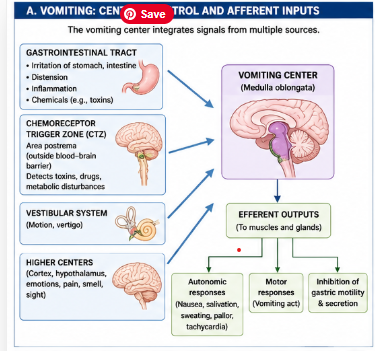
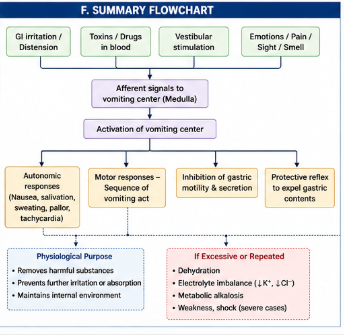
Nausea begins when sensory signals from the gastrointestinal tract, vestibular system, higher brain centers, or blood-borne chemicals reach the vomiting center in the medulla.
Irritation of stomach or intestine sends signals through vagal and sympathetic afferents. Drugs and toxins stimulate the chemoreceptor trigger zone. Motion sickness stimulates the vestibular apparatus. Emotional stress and bad smell may stimulate higher cortical centers.
The vomiting center integrates these signals and activates autonomic responses. This explains why nausea is associated with increased salivation, sweating, pallor, and altered heart rate.
⚠️ IF DAMAGED
- GI irritation → excessive afferent stimulation → nausea
- Toxins in blood → stimulation of chemoreceptor trigger zone → nausea
- Vestibular disturbance → motion sickness → nausea
- Persistent nausea → reduced oral intake → dehydration and electrolyte imbalance
Physiology Objective 2: Mechanism of Vomiting
🧠 CORE
- Vomiting is a coordinated reflex controlled by the medulla.
- The vomiting center receives input from many sources.
- Important inputs include GI tract, chemoreceptor trigger zone, vestibular system, and cerebral cortex.
- Vomiting involves reverse movement of upper GI contents.
- It requires coordinated contraction of abdominal muscles and diaphragm.
- Lower esophageal sphincter relaxes during vomiting.
- Glottis closes to protect the airway.
- Vomiting removes harmful or excessive gastric contents.
🔬 CONCEPT EXPLAINED
Vomiting is not simply reverse peristalsis. It is a highly coordinated motor reflex. The vomiting center in the medulla receives signals from the gut, blood, inner ear, and brain.
Once activated, the vomiting center sends motor signals to the diaphragm, abdominal muscles, stomach, esophagus, pharynx, and respiratory muscles.
The stomach itself does not provide the main force. The major force comes from contraction of abdominal muscles and diaphragm. At the same time, the lower esophageal sphincter relaxes and the glottis closes to prevent aspiration.
⚠️ IF DAMAGED
- Failure of airway protection → aspiration of vomitus
- Excessive vomiting → dehydration
- Loss of gastric acid → metabolic alkalosis
- Loss of potassium → hypokalemia
- Severe vomiting → weakness, shock, and electrolyte disturbance
Physiology Objective 3: Vomiting Act
🧠 CORE
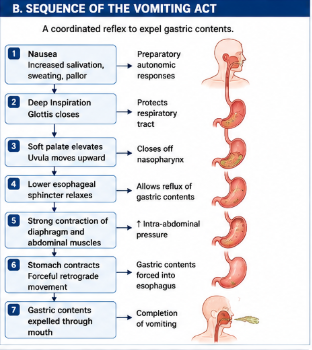
- Vomiting act occurs in a sequence.
- It usually begins with nausea and salivation.
- Deep inspiration occurs before vomiting.
- Glottis closes to protect lungs.
- Soft palate elevates to protect nasal cavity.
- Lower esophageal sphincter relaxes.
- Abdominal muscles and diaphragm contract forcefully.
- Gastric contents are expelled through mouth.
🔬 CONCEPT EXPLAINED
The vomiting act is a coordinated protective reflex.
First, nausea develops and salivation increases. Saliva helps protect the mouth and esophagus from acidic gastric contents.
Then deep inspiration occurs, followed by closure of the glottis. This prevents vomitus from entering the respiratory tract. The soft palate elevates, preventing entry into the nasal cavity.
The diaphragm and abdominal muscles contract strongly. This increases intra-abdominal pressure. The lower esophageal sphincter relaxes, allowing gastric contents to move upward into the esophagus and out through the mouth.
⚠️ IF DAMAGED
- Poor glottic closure → aspiration pneumonia
- Repeated vomiting → esophagitis
- Acid exposure → dental erosion
- Excessive abdominal pressure → pain and weakness
- Severe fluid loss → dehydration
Physiology Objective 4: Gastrointestinal Obstruction
🧠 CORE
- GI obstruction means blockage of intestinal contents.
- It may be mechanical or functional.
- Mechanical obstruction occurs due to physical blockage.
- Functional obstruction occurs due to failure of motility.
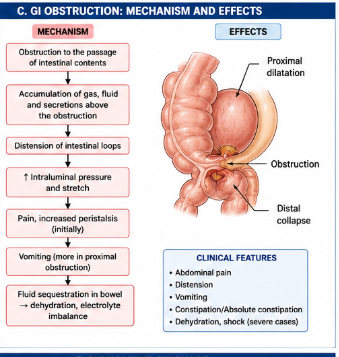
- Obstruction causes accumulation of fluid, gas, and intestinal contents.
- It produces distension, pain, vomiting, and constipation.
- Proximal obstruction causes early vomiting.
- Distal obstruction causes marked distension and constipation.
🔬 CONCEPT EXPLAINED
Normal intestinal movement depends on coordinated peristalsis. If the lumen is blocked, contents cannot move forward.
Above the obstruction, gas and fluid accumulate. This stretches the bowel wall and causes distension. Distension activates pain fibers and increases peristaltic activity initially.
As obstruction worsens, vomiting may occur. In upper intestinal obstruction, vomiting appears early because the blockage is near the stomach. In lower obstruction, abdominal distension is more prominent because more intestine is involved.
⚠️ IF DAMAGED
- Obstruction → accumulation of gas and fluid → abdominal distension
- Distension → pain and increased peristalsis
- Persistent obstruction → vomiting and dehydration
- Fluid sequestration in bowel → hypovolemia
- Severe obstruction → ischemia and perforation risk
Physiology Objective 5: Gases in Gastrointestinal Tract — Flatus
🧠 CORE
- Gas is normally present in the GI tract.
- Sources include swallowed air and bacterial fermentation.
- Major gases include nitrogen, oxygen, carbon dioxide, hydrogen, and methane.
- Most swallowed air is expelled by belching.
- Colonic bacteria produce gases during fermentation.
- Flatus is expelled through the anus.
- Excess gas causes bloating, discomfort, and abdominal distension.
- Gas movement depends on intestinal motility.
🔬 CONCEPT EXPLAINED
Gas enters the GI tract mainly by swallowing air during eating and drinking. Some gas is also produced by bacterial fermentation of undigested carbohydrates in the colon.
The stomach removes much of swallowed air by belching. Gas that passes into the intestine moves along with intestinal contents.
In the colon, bacteria break down unabsorbed food substances and produce gases. These gases are expelled as flatus. The amount of flatus depends on diet, gut bacteria, digestion, and motility.
⚠️ IF DAMAGED
- Poor carbohydrate digestion → more substrate for bacteria → excess gas
- Reduced motility → gas retention → bloating
- Obstruction → trapped gas → severe distension
- Excess fermentation → increased flatus
- Impaired gas expulsion → abdominal discomfort
Biochemistry Objective: Composition of Intestinal Juices
🧠 CORE
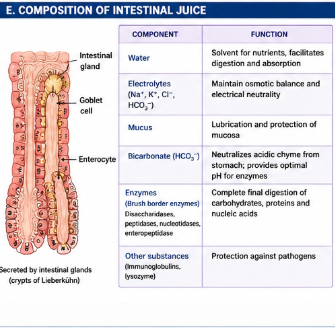
- Intestinal juice is secreted mainly by intestinal glands.
- It contains water, electrolytes, mucus, bicarbonate, and enzymes.
- Water helps dissolve nutrients.
- Electrolytes maintain fluid balance.
- Mucus lubricates and protects intestinal mucosa.
- Bicarbonate helps neutralize acid.
- Brush border enzymes complete digestion.
- Intestinal secretions support absorption.
🔬 CONCEPT EXPLAINED
Intestinal juice provides the correct fluid environment for digestion and absorption. Water acts as a solvent and helps nutrients move close to absorptive cells.
Mucus protects the intestinal lining from mechanical irritation and chemical damage. Bicarbonate neutralizes acidic chyme entering from the stomach and protects enzymes that work best in neutral or alkaline pH.
Brush border enzymes are attached to the surface of enterocytes. They complete final digestion of carbohydrates and proteins before absorption.
Important functional molecules include:
- Mucus: protection and lubrication
- Bicarbonate: acid neutralization
- Electrolytes: osmotic balance
- Brush border enzymes: final digestion
- Water: medium for absorption
⚠️ IF DAMAGED
- Reduced mucus → mucosal irritation
- Reduced bicarbonate → acid injury and poor enzyme activity
- Excess secretion → diarrhea
- Reduced secretion → poor digestion and constipation tendency
- Enzyme deficiency → malabsorption and bloating
⚙️ 4️⃣ Functional Flow
Structure → Function → Outcome
- Medulla vomiting center → coordinates vomiting reflex → expulsion of harmful contents
- Chemoreceptor trigger zone → detects blood-borne toxins → initiates nausea and vomiting
- Glottis → closes during vomiting → prevents aspiration
- Soft palate → elevates during vomiting → prevents nasal regurgitation
- Abdominal muscles and diaphragm → increase intra-abdominal pressure → forceful expulsion
- Intestinal smooth muscle → produces peristalsis → moves contents forward
- Colon bacteria → ferment undigested food → gas formation
- Intestinal glands → secrete fluid and mucus → digestion, lubrication, and protection
- Brush border enzymes → complete digestion → absorption-ready nutrients
🩺 5️⃣ Clinical Correlation
1. Motion Sickness
- Vestibular stimulation activates vomiting center.
- Causes nausea, dizziness, sweating, and vomiting.
- Common during travel.
2. Food Poisoning
- Toxins irritate GI tract and stimulate chemoreceptor trigger zone.
- Vomiting helps remove harmful contents.
3. Intestinal Obstruction
- Presents with abdominal pain, distension, vomiting, and constipation.
- Proximal obstruction causes early vomiting.
- Distal obstruction causes marked distension.
4. Pyloric Obstruction
- Gastric emptying is blocked.
- Causes recurrent vomiting.
- Loss of gastric acid may cause metabolic alkalosis.
5. Aspiration Pneumonia
- Occurs when vomitus enters the respiratory tract.
- More likely if airway protective reflexes fail.
6. Diarrhea Due to Excess Intestinal Secretion
- Excess secretion of water and electrolytes into intestinal lumen causes watery stools.
- May lead to dehydration and electrolyte imbalance.
7. Lactose Intolerance
- Undigested lactose reaches colon.
- Bacteria ferment lactose.
- Causes gas, bloating, abdominal cramps, and diarrhea.
📌 6️⃣ Summary Points
- Nausea is the unpleasant sensation that usually precedes vomiting.
- Vomiting is coordinated by the vomiting center in the medulla.
- Chemoreceptor trigger zone detects toxins and drugs in blood.
- The main force of vomiting comes from abdominal muscles and diaphragm.
- Glottic closure prevents aspiration during vomiting.
- Repeated vomiting causes dehydration, hypokalemia, and metabolic alkalosis.
- GI obstruction causes accumulation of gas, fluid, and contents above the blockage.
- Proximal obstruction causes early vomiting.
- Distal obstruction causes marked abdominal distension.
- Flatus is mainly due to swallowed air and bacterial fermentation.
- Intestinal juice contains water, electrolytes, mucus, bicarbonate, and enzymes.
- Mucus protects, bicarbonate neutralizes acid, and enzymes complete digestion.